The Red House haunting hoax
Partners in CrimeThe Red House haunting hoax is a staged series of apparently supernatural disturbances used to drive visitors from the Red House and pressure its new owner into selling. Its force lies in the gap between spectacle and motive: crockery flies, furniture is overturned, and a jug and basin are smashed in an empty room, while the growing offers to buy the property point Tommy toward a human plot—and toward something hidden there.
The House and Its Disturbances
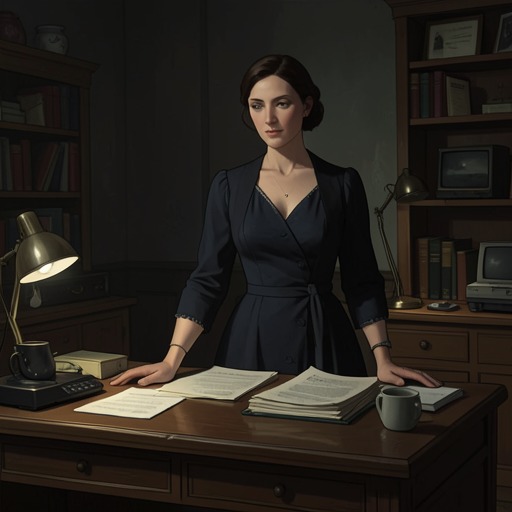
Monica Deane and her mother move into the house inherited from Monica’s aunt after declining an advantageous offer to sell it. They hope to make ends meet by taking paying guests. For a time the arrangement works: guests answer the advertisement, and Crockett, the aunt’s elderly servant, stays on and helps Monica with the housework. Then unexplained disturbances begin, threatening the household’s fragile attempt at financial independence.
The episodes are deliberately domestic and conspicuous. Pictures fall, crockery flies across rooms and breaks, and the furniture is found rearranged. At dinner, a crash from upstairs sends the family to investigate; they find no one there, only furniture violently thrown to the floor. The supposed haunting thus attacks not an isolated room but the ordinary routines on which the household depends, making the guests’ sense of safety—and their willingness to stay—part of the plot’s target.
The consequences soon become material. Frightened visitors leave as quickly as they can, and replacements also depart. Monica’s family is already poor, and the small income they had relied on ceases when the company holding it fails. The house, initially the solution to their difficulties, becomes a source of distress and financial pressure. Against that background, the disturbances are not merely frightening tricks: they help make the property’s continued occupation untenable.
The Offer to Buy
Three days before Monica tells her story to Tommy and Tuppence, a man calling himself Dr. O’Neill visits. He claims membership in the Society for Physical Research and says he has heard of the manifestations. His interest appears to offer Monica a way out: he is prepared to buy the house and conduct experiments there. Yet his scientific explanation is joined from the outset to a property offer, making the supposed investigator’s role inseparable from the suspicious eagerness to acquire the building.
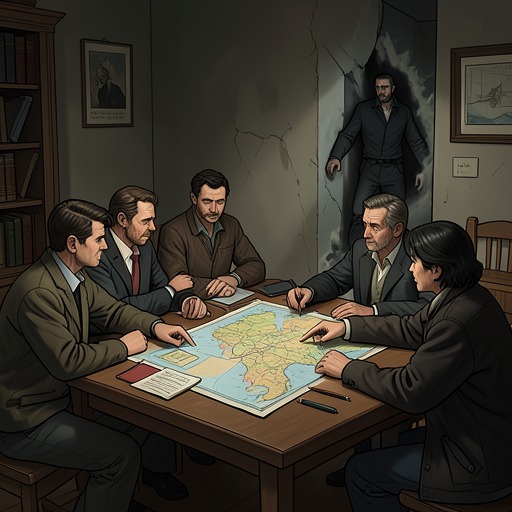
Monica had already refused an earlier offer from the gentlemen who wanted to buy the house, even after moving in. That history makes the haunting’s commercial direction plain to Tommy: a straightforward burglary would not require anyone to purchase the property. He reasons that the would-be buyers must need access to something that could be reached by taking up floors or pulling down walls, or perhaps to a coal mine beneath the back garden. Tuppence prefers the possibility of buried treasure, giving a romantic name to the same essential clue: the house itself may conceal the object of the campaign.
A renewed offer strengthens the suspicion. Tommy tells Monica that he will willingly beat the other buyer’s price by £100, then watches how the household responds. After the Beresfords leave, Monica reports that Dr. O’Neill has raised his previous offer by £150. The sequence turns an abstract suspicion into a contest of bids: rather than deterring the supposed investigator, Tommy’s willingness to buy provokes him to pay more. Tommy concludes that the nephew must have means and that whatever he seeks in the house is worth a substantial effort.
Tommy Tests the Household
The staged effects continue while the Beresfords are present. Monica has gathered papers in a large cardboard box for them to examine, but a crash overhead interrupts her. Tommy runs upstairs and finds a jug and basin smashed on the floor of a front room; nobody is there. His remark about the ghost being at work again carries a double edge: he treats the apparent marvel as a repeatable act, and the empty room as a clue to the method rather than proof of a supernatural presence.
Tommy also tests the people who have access to the house. He asks Crockett whether she would remain in service if he and Tuppence bought the property. She displays no emotion and asks time to consider. As they leave, Tommy says he believes Crockett is involved. He has noticed that she is out of breath and infers that she has run down the back stairs after smashing the jug and basin. The timing supplies a practical explanation for the empty room: the sound draws attention upstairs while the person responsible has already made her way out.
Tommy’s account allows for more than one participant. He suspects that Crockett may sometimes admit her nephew secretly, enabling him to create disturbances while she appears to be innocently with the family. This remains his proposed reconstruction at that point, not a confirmed explanation of every effect. But it gives the haunting a plausible human mechanism and connects the maid’s access to the house with the suspected buyer’s campaign to obtain it.
Concealment, Disguise, and Deception
Other incidents in the story give the investigation a wider pattern of false appearances. When Elise tries to open a bedroom door, the handle first rattles without opening. She says somebody must have locked it from the other side; when she tries again, it turns easily, and the bedroom is empty. Elise concludes that the door must have stuck. The moment does not establish a link to the Red House scheme, but it echoes the story’s recurring problem: a visible irregularity invites a quick explanation, while the decisive fact may be an unseen person’s access or a concealed method.
At the office, Mr. Carter warns Tuppence that a Russian operative may use a Blue letter to lure her to Hampstead and leave the International Detective Agency office empty. He thinks the man may believe Tommy is the legitimate purchaser of Mr. Blunt’s business and therefore expect the letter to be filed as ordinary business. Elsewhere, Tommy and Tuppence consider how a man could use a turf shelter beside the sixth tee at Sunningdale Golf Links to change his appearance, wearing a skirt over plus fours and then removing it to pass as a man again. These episodes are not evidence that those schemes form part of the Red House haunting, but they sharpen the book’s broader attention to access, disguise, and the way ordinary surroundings can conceal deliberate action.
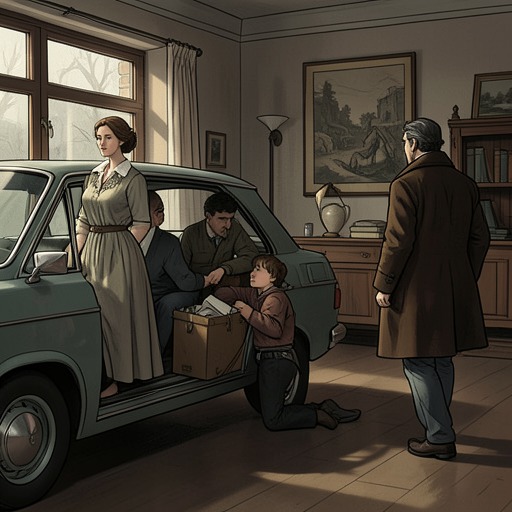
That pattern reaches a darker conclusion in the later abduction of Tuppence. Tommy finds a bundle beneath a sofa containing her long black coat, walking dress, hat, and a long fair beard. He reconstructs how the Russian operative and his accomplices may have used a nurse and a boy, familiar to the hotel staff from earlier visits, to take Tuppence away in disguise. A fragment of a hypodermic needle on the carpet confirms that she had been drugged. This is a separate criminal operation, not the resolution of the Red House mystery; its relevance is the book’s repeated contrast between a staged appearance and the concealed action that makes it possible.
What the Hoax Establishes
The Red House episodes make apparently inexplicable events legible through motive, opportunity, and physical aftermath. A broken jug and basin, an employee out of breath, and a buyer who raises his offer each change the meaning of what came before. The haunting’s credibility rests on the witnesses’ inability to see the person responsible at the moment of action; Tommy’s investigation replaces supernatural certainty with a testable account of access and concealment.
The evidence supplied for this action establishes the deception’s broad design and Tommy’s working explanation: the disturbances frighten off guests, an ostensible researcher offers to buy the house, Crockett appears implicated, and the escalating price suggests a valuable reason for wanting the property. It does not disclose what the suspected buyer hopes to find, nor does it provide a final account of how every manifestation was produced. The mystery therefore remains focused on a house whose most conspicuous feature is its apparent haunting, while its strongest clue is the human persistence behind the effort to acquire it.